

Have you always thought that AI is just a chatbot – you ask it, it answers, and at most it helps you write a copy or change a code? If that’s the case, you haven’t seen the true potential of AI. The emergence of AI Agent marks a fundamental shift from “talking” to “doing” in AI. AI Agent is not just a big model dialog, but an intelligent executor that can plan, call tools, and complete multi-step tasks on its own. This Getting Started with AI Agents guide takes you from the ground up to understand what an AI Agent is, how it works, what it can do, and how to get started.
What’s an AI Agent: a leap in thought modeling
The Common Large Model (LLM) does one thing: generates text. You give the input, it gives the output, and that’s it.
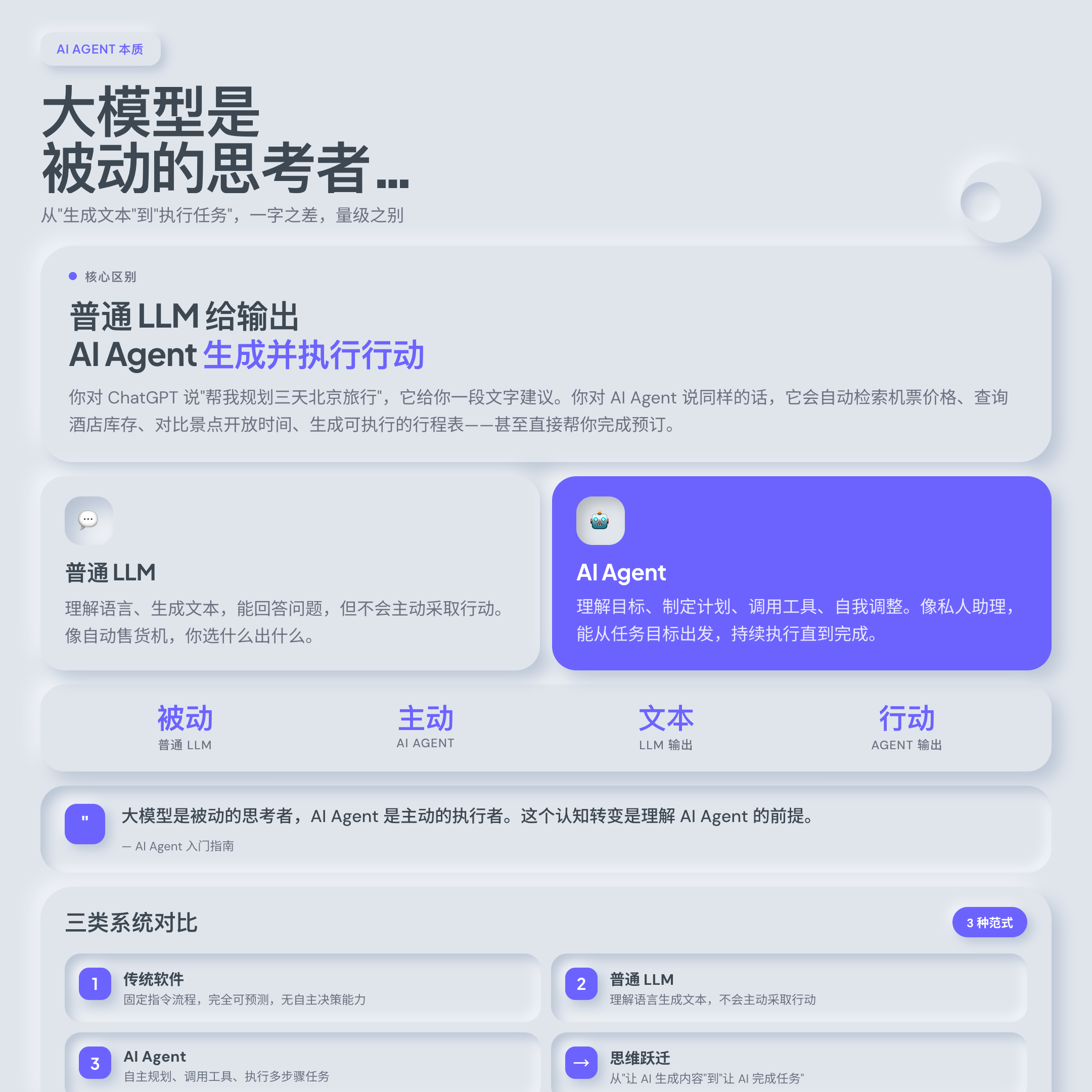
The AI Agent does another thing: generates actions and executes them. That’s a quantum difference in one word.
Let’s use a concrete example to get a feel for it. You say to ChatGPT, “Help me plan a three-day trip to Beijing with a budget of 5,000 RMB,” and it gives you a text suggestion. You say the same thing to an AI Agent, and it automatically retrieves airfares, checks hotel inventory, compares opening times for attractions, and generates an actionable itinerary – and if you authorize it, it can even complete the booking directly for you.
This is the core difference between traditional software, regular LLMs and AI Agents:
- Traditional software: fixed instruction flow, input→processing→output, like a vending machine, what you pick comes out, completely predictable
- Common LLM: understands language, generates text, can answer questions but doesn’t initiate action
- AI Agent: understand the goal, make plans, call tools, self-adjustment, like a personal assistant, can start from the task goal, continue to execute until completion
**Remember: big models are passive thinkers, AI Agents are active performers. **
This cognitive shift is a prerequisite for understanding AI Agents. Many people learn the Prompt trick half the time without realizing that Agent represents a completely different usage paradigm.
AI Agent’s Core Formula: 4 Modules Dismantled for Clarity
The most straightforward way to understand how an AI Agent works is to look at this formula:
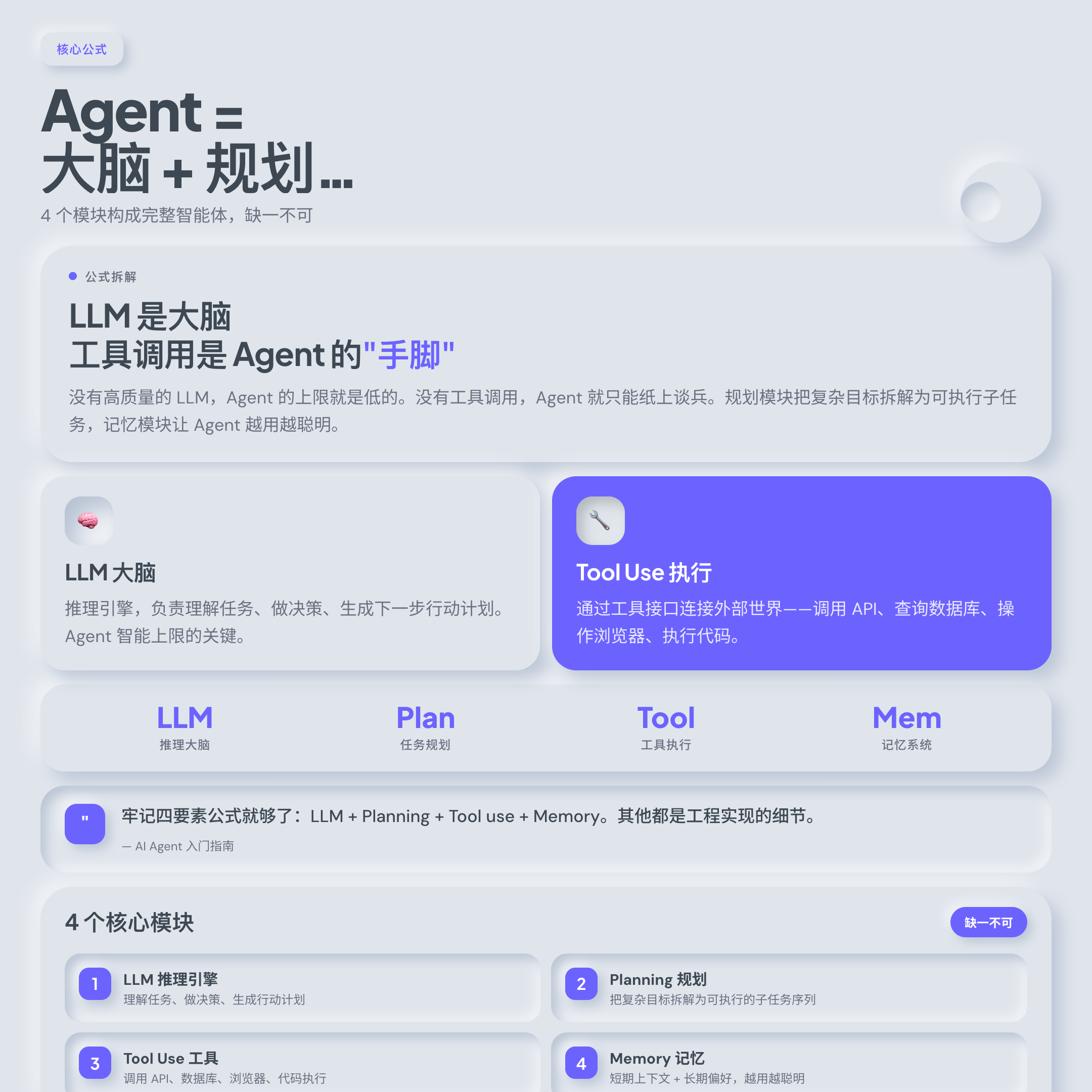
Agent = LLM (brain) + Planning + Tool use + Memory
This formula has been widely validated in both academia and industry. Take it apart:
LLM (brain): reasoning engine, responsible for understanding the task, making decisions, and generating the next action plan. Without a high-quality LLM, the Agent’s ceiling is low.
Planning: task decomposition capability. Break down a complex user goal into a sequence of executable subtasks. For example, “planning a trip” will be broken down into four subtasks: checking airfare, checking hotels, checking attractions, integrating outputs, and deciding on the order of execution.
Tool use: the “hands and feet” of the Agent. Connecting to the outside world through tool interfaces – calling APIs, querying databases, manipulating browsers, executing code. Without tool calls, an Agent is just a piece of paper.
Memory: short-term memory and long-term memory. Short-term memory maintains the context of the current task (e.g., the history of conversations you’ve had in the same session), while long-term memory stores user preferences, historical task results, and allows the Agent to get smarter the more it’s used.
Interestingly, the AWS official blog (September 2025) further refines these four modules into a complete engineering architecture in the actual production system: Reasoning Engine, Memory System, Orchestration, Tool Interface. The four modules are further refined into a complete engineering architecture: Reasoning Engine (Memory System), Orchestration Module (Orchestration), Tool Interface (Tool Interface), plus four support services: Quality Assessment, Authentication, Security Protection, Observability, to form a set of production-grade Agent System.
But for beginners, it’s enough to keep that four-element formula in mind. Everything else is a detail of engineering implementation.
What an AI Agent Can Do: From Simple Automation to Complex Multi-Step Tasks
After understanding the principle of AI Agent, the most concerned question comes: what exactly can AI Agent help me do?
Information Retrieval and Aggregation: Give Agent a research task and it automatically searches multiple sources, filters relevant information, and generates structured reports. Instead of you manually copying and pasting, it automatically performs the entire process.
Browser actions: filling out forms, clicking buttons, taking screenshots of records – Agent can operate web pages like a human being, completing those repetitive web page operation tasks.
Code execution and debugging: writing code is only the first step, Agent can run the code directly in the sandbox environment, check the results, according to the error message automatically correct, forming a complete closed loop of “write – test – change”.
Cross-system workflows: This is Agent’s strongest scenario. For example, “when a customer updates their status in the CRM, automatically generate a contract in the internal system, send an email to the corresponding salesperson, create a follow-up reminder on the calendar” – automation across multiple systems that used to require specialized engineers to develop, but now Agent can handle.
Personal Assistant Scenarios: managing calendars, handling email prioritization, organizing information, generating weekly reports – these kinds of highly repetitive but contextually demanding tasks are the sweet spot for Agents.
Scratch that:** Agents don’t excel in scenarios that require creativity, require precise perception of the physical world, or need to handle high-stakes decisions. ** Boundaries need to be clear in order to be used in the right places.
The real challenge of landing an AI Agent: production environments are not the same as prototypes
Many people get started with AI Agents under the illusion that the technical barrier is low and that they can build an Agent by running a few lines of code. this judgment is only half right.
The technical threshold for building Agents is indeed decreasing – mainstream open source frameworks (LangGraph, CrewAI, Strands Agents) all provide packaged modules that can run a basic AI Agent in a few dozen lines of code.
But here’s the thing: there’s a real engineering gap between “running” and “stable in a production environment”.
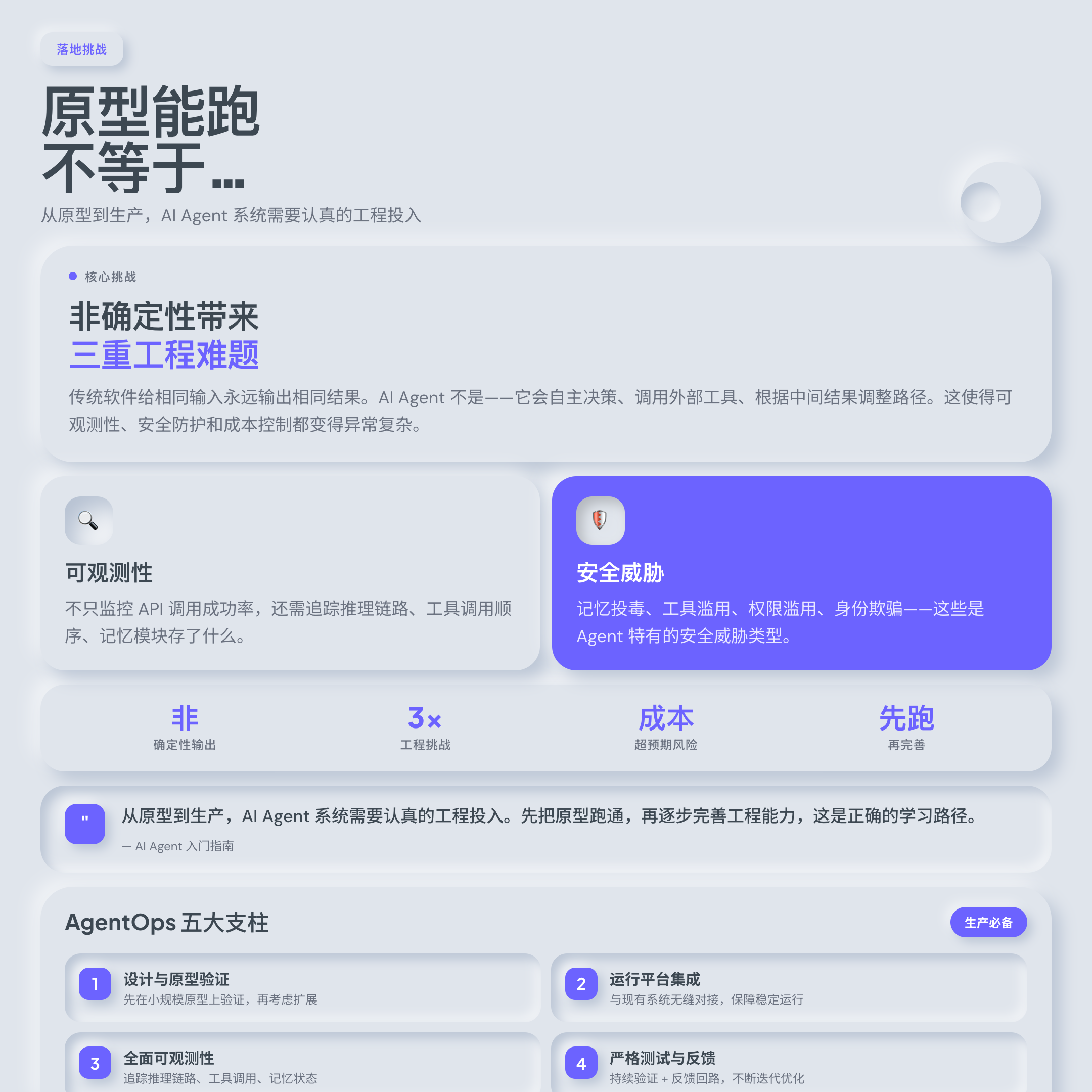
The most unique challenge of an Agent system comes from its non-determinism. Traditional software gives the same inputs and always outputs the same results. an AI Agent is not – it makes autonomous decisions, calls external tools, and adjusts its path based on intermediate results. This makes:
- Observability gets complicated: you don’t just need to monitor the success rate of API calls, you also need to track the Agent’s “thought process” – does the reasoning link make sense? Are the tools being called in the right order? What’s in the memory module?
- Security threats are agent-specific: The OWASP Agentic AI Threat Model (for which there is already an official Top 10 list) explicitly lists memory poisoning, tool misuse, privilege abuse, identity spoofing, and other threats. Identity Spoofing) and other types of threats that traditional AI security does not address.
- Cost control is more difficult: multi-step tasks trigger a large number of LLM calls, and the Token cost may be much higher than expected.
AWS addresses this challenge with the concept of AgentOps – extending DevOps and MLOps Ops capabilities to Agent systems, with core pillars of design/prototype validation, operational platform integration, full observability, rigorous test validation, and continuous feedback loops.
This is not to dissuade you, but to help you set the right expectations:** From prototype to production, AI Agent systems require serious engineering input. It’s the right learning path to run through the prototype first, and then gradually refine the engineering capabilities. **
How to start learning AI Agent: an action path for beginners
Enough theory, let’s talk about how to do it.
Step 1: Build a Conceptual Framework for AI Agent (1-2 days)
Don’t just come up and run code. First of all, the Agent’s core concepts clear: what is the Prompt chain, what is Tool Calling, what is the ReAct mode (Reasoning + Acting), what is Multi-Agent collaboration. These concepts are the basis for all subsequent practice.
Recommended Resource:
– Google’s 5-day Agent course (free and systematic)
– Microsoft’s AI Agents for Beginners open source course (GitHub can be found directly)
– HuggingFace Intelligent Body Course (practical, with code samples)
Step 2: Running through a minimal AI Agent (1-3 days)
Choose either LangGraph or CrewAI (LangGraph is recommended for a more mature ecosystem), and follow the official tutorials to run through the simplest possible Agent – e.g., a single Agent that can call a search API to answer questions.
The goal of this step is not to build a useful product, but to feel the complete cycle of “Planning → Action → Memorization → Output “.
**Step 3: Find your first real use case (key) **
The best way to learn is to practice. But practicing is not the same as following a tutorial and building a wheel over and over again, it’s about finding a real pain point in your actual work and solving it with Agent.
A good beginner’s use case should meet the following criteria: clear task boundaries, manageable consequences of failure, and clear success criteria. For example, “Automatically organize weekly reports on competitor dynamics”, “Summarize daily sales data from multiple data sources” – these tasks have practical value, but will not cause serious consequences due to Agent errors.
Step 4: Progressive expansion of complexity
After the single Agent runs through, you can gradually introduce: multi-tool invocation, long-term memory, multi-Agent collaboration (Multi-Agent), and manual review nodes (Human-in-the-loop). Each step should be validated on a small-scale prototype before considering scaling.
Written at the end
The core of the AI Agent is not the complexity of the technology, but a shift in the mindset model: from “let AI generate content for me” to “let AI complete tasks for me “.
The value of technology lies in solving problems, not in showing off. You don’t need to be well versed in all the underlying principles to use Agent well – but you do need to be aware of the boundaries of its capabilities and know what’s appropriate for Agent and what’s not.
Instead of waiting for Agent technology to become more mature, you should find a small task and start practicing now. When you look back a year from now, the biggest difference is not who has the best technology, but who has started to accumulate real-world Agent experience earlier.
AI won’t replace you, but those who can use it will. This statement is closer to reality than ever before in the Agent era.
We hope this AI Agent Getting Started Guide will help you establish a clear cognitive framework and find your own starting point.
If this article was helpful to you, feel free to leave a comment to discuss.