
When AI starts "thinking": will your job be refactored?
At 6 a.m., when office buildings in Lujiazui, Shanghai, are still shrouded in the morning sun, the intelligent customer service system is already automatically handling tens of thousands of customer inquiries. This is not an ordinary AI response – it can accurately recognize customer sentiment, autonomously coordinate resources across multiple departments, and even predict the risk of potential complaints based on historical data. You may not realize that this AI intelligence with the ability to think on its own is redefining the rules of the game in the modern workplace.
I. Traditional AI subversives are waking up
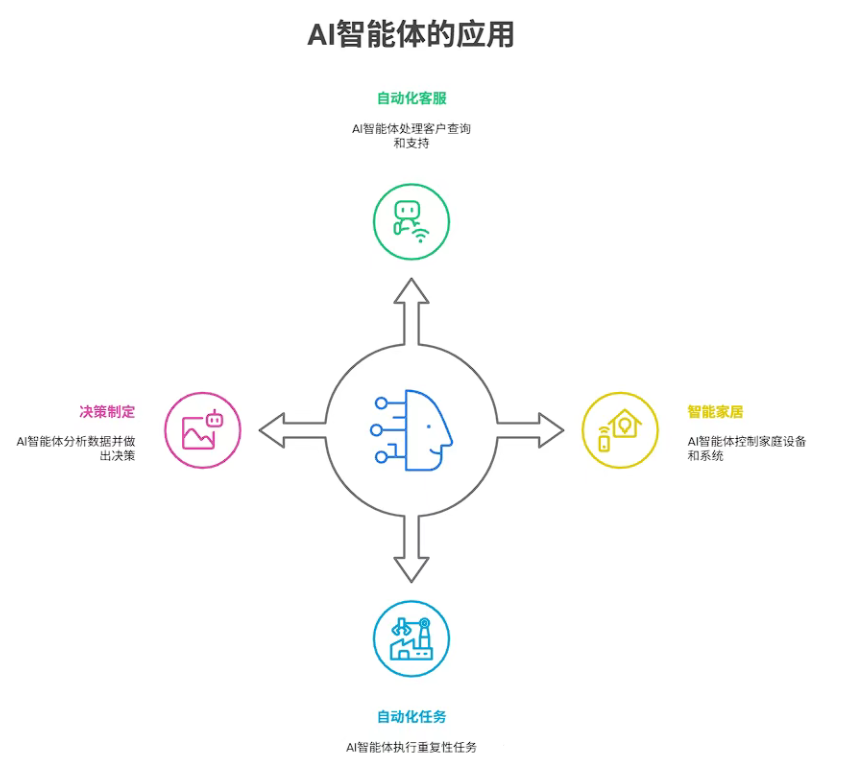
Open the voice assistant in the cell phone, it will only mechanically execute the instructions; customer service robots on the web page, always repeating the preset lines. But these primary AIs are nothing more than steam engines in the digital age in front of the new intelligences. The real revolution comes from those AI intelligences that can think and make decisions on their own:
- It knows how to observe the environment: it can synchronize and parse multi-dimensional information such as text, voice, video, etc., and understand complex scenes like humans
- It can plan proactively: it breaks down "generating quarterly sales reports" into 15 steps such as data extraction, trend analysis, and icon creation
- It has a long-term memory: the last time you adjusted the PPT color scheme, this time to do the market report will automatically continue the visual style
- It can collaborate and evolve: in a cluster of medical intelligences, the diagnostic imaging AI will ask the pathology analysis AI for advice on difficult cases
.
.
At one multinational pharmaceutical company, the intelligent body system has compressed the new drug approval process from 26 months to 14 months. They are like a digital version of "Iron Man", and are building an invisible intelligence hub in the back office of the enterprise.
Two or three groups of control perspective intelligent body revolution
| Traditional chatbots | AI Assistant | AI Intelligentsia | |
|---|---|---|---|
| Task Complexity | Single Question and AnswerSimple Transaction ProcessingMulti-system CollaborationLearning Evolution | Script PresetsLimited Scenario OptimizationContinuous Iterative Work Strategy
III, the evolution of the new species of workplace mapping
These digital employees are penetrating every industry capillary:
- Financial Brain: An investment bank’s risk control intelligence body can monitor 3,000 market indicators in real time and warn of potential risks 12 hours ahead of time
- Medical Detective: Shanghai’s AI imaging system has been able to autonomously label lesions with an accuracy rate that exceeds 85% of residents
- Creative Partners: A 4A company’s intelligent body cluster realizes a complete creative closed loop from strategy analysis to video production
- Industry Doctors: A power inspection smart body group automatically divides the workload and reduces fault location time from 8 hours to 12 minutes
What’s even more amazing is the way they work: a multi-intelligence system in a multinational conglomerate debates the merits of a solution like a human team, and then votes on the optimal solution at the end.
IV. The Song of Ice and Fire in the Age of Intelligence
When a manufacturing company’s intelligent body system autonomously revised production plans to avoid typhoon affected ports, human managers suddenly realized: these digital colleagues are breaking through the boundaries of preset. The intelligent-body revolution has brought about more than just leaps in efficiency:
- The ethical black box: when medical intelligences recommend abandoning treatment, is the basis of the decision traceable?
- Human-machine trust: Do financial institutions dare to give intelligences carte blanche to operate hundreds of millions of dollars?
- Skills disconnect: How can middle managers live with themselves when interns can command AI teams?
Research from a consulting firm shows that 78% of white-collar workers are worried about being replaced by intelligentsia, and that the real crisis is coming from those workers who can’t use intelligentsia-their productivity gap is widening by 30% per year.
V. The new ecology of business in the reconstruction
Headline companies have launched an arms race for smart bodies:
- Google’s Agent Builder: allows enterprises to customize proprietary intelligences with natural language
- IBM’s Cognitive Factory: swarms of intelligences autonomously optimize the supply chain for zero inventory turnover NVIDIA’s Swarm System: 200 intelligences collaborate to manage data center energy consumption
.
Transformation insights from a retail giant: When intelligent bodies took over 80% of operational decisions, management was freed from day-to-day matters to focus on strategic innovation, increasing annual revenue growth by 42%.
In this era of exponential evolution of intelligent bodies, the real winner is not the technology that replaces humans, but a new type of organization that knows how to coexist with intelligent bodies. The workplace of the future is no longer a competition between humans and machines, but a contest between those who can use AI and those who can’t. When every ordinary person can mobilize a legion of intelligent bodies, the boundaries of individual creativity will be infinitely extended in human-machine synergy.