OpenClaw Lobster’s Core Design Idea: Why This AI Agent Collected 247k Stars in 4 Months
With 247,000 GitHub Stars, 47,700 Forks, 3 name changes, and 4 months, OpenClaw, a solo project released by an independent Austrian developer in November 2025, has become the most talked about open source tool in the AI Agent space. Its GitHub home page still reads, “Your own personal AI assistant. Any OS. Any Platform. The lobster way. 🦞”. What makes this lobster so special?
From Clawdbot to Lobster: a declaration of values behind a naming fiasco
The project was originally called Clawdbot – the name came from Anthropic’s Claude, with obvious homage.2026 On January 27, 2026, Anthropic sent a trademark complaint and Steinberger was forced to change the name to Moltbot ( Molting Lobster, staying true to the lobster theme). Three days later, he decided the name was “too much of a mouthful” and settled on OpenClaw.
These three name changes are more than just branding tosses – they reflect Steinberger’s fundamental approach to the project: open source, independent, and not tied to any single giant. OpenClaw supports access to Claude, GPT-4o, DeepSeek, Gemini, native Ollama and other LLMs, and is never tied to any one vendor.
On February 14, 2026, Steinberger announced that he was joining OpenAI, along with the announcement that OpenClaw would be handed over to a nonprofit foundation and “remain open source and independent forever.” In a blog post, he wrote: “What has always been important to me is that OpenClaw remains open source and is given the freedom to evolve.”
**Highlight: OpenClaw is not a product, it’s an experiment in data sovereignty. **
Brains & Muscles: An Architecture That Lets AI Really “Work”
Most AI tools are designed like this: one model, all the capabilities, user interaction through a web UI, and data on a cloud server. openClaw is the complete opposite.
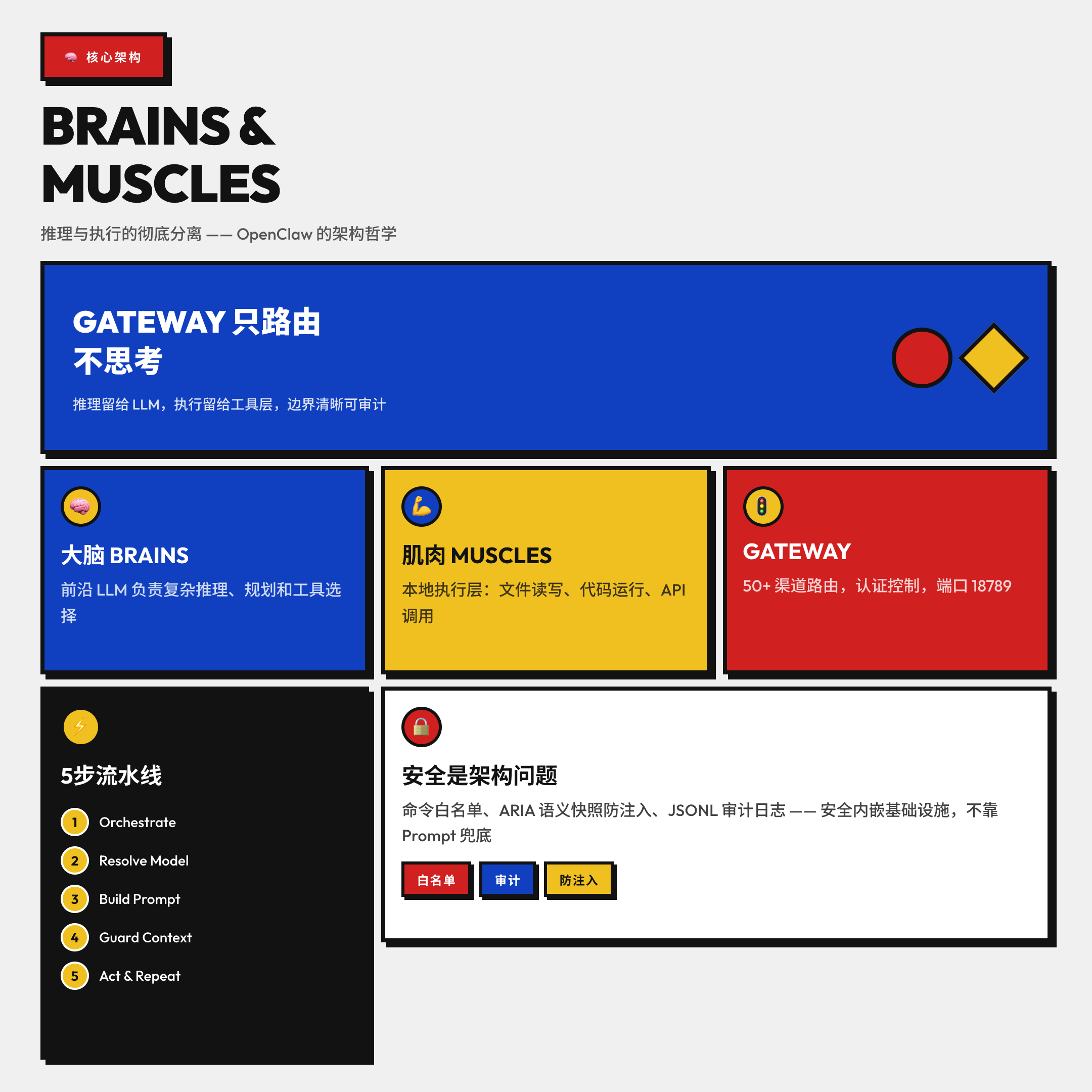
Its core architecture is called Brains & Muscles (Brains & Muscles):
Brains: Frontier LLMs (Claude, GPT-4o, etc.) are responsible for complex reasoning, planning, and tool selection. They’re the thinkers, but they don’t touch your filesystem directly.
Muscles: the local execution layer that does the actual work – reading and writing files, running code, browser manipulation, API calls. The execution layer has full access control and needs explicit authorization to do what it wants to do.
In between is the Gateway: essentially a Node.js process running on port 18789 that routes input from 50+ messaging channels such as Telegram/WhatsApp/Discord/Slack to the correct Agent instance. the Gateway itself “doesn’t think” – it’s just the traffic cop making sure each message finds the right Agent while doing authentication and concurrency control. –The Gateway itself “doesn’t think” – it’s just the traffic cop, making sure each message finds the right Agent, and doing authentication and concurrency control.
The great thing about this design is that scalability and security can be done well at the same time. You can restrict an Agent from deleting files without affecting its ability to invoke search tools. The boundaries between reasoning and execution are clear, and audit logs (in JSONL format) record every operation – and when something goes wrong, it can be played back in full.
The interesting thing is that OpenClaw’s security policy doesn’t rely on adding “please don’t do bad things” to a Prompt, but rather on command whitelisting and structured parsing at the infrastructure level. Prompt Injection is an architectural level defense, not a Prompt level prayer.
Skills Systems: Why OpenClaw can be a platform, not just a tool
The difference between an AI Agent tool and an AI Agent platform is the ability to allow the community to extend its capabilities indefinitely. openClaw chose the latter.
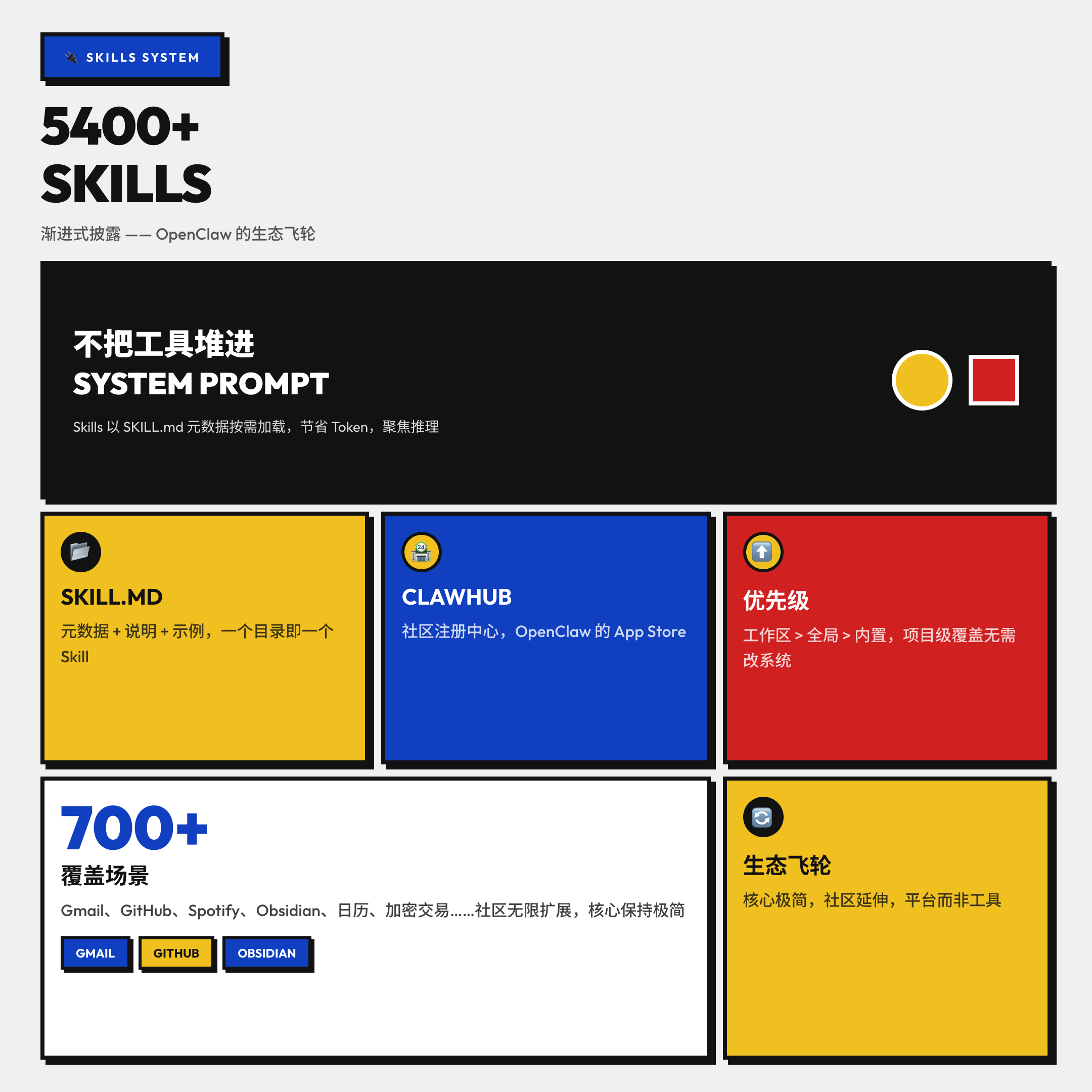
The core idea behind the Skills system is Progressive Disclosure: instead of piling all the tool descriptions into the System Prompt (which wastes a lot of tokens and confuses the model), each Skill is stored in a separate SKILL.md file, which the model reads on demand.
On the community Registry ClawHub, there are reportedly 5,400+ categorized Skills covering Gmail automation, GitHub PR management, Spotify playback control, Obsidian note management, cryptocurrency trading, …… almost any workflow you want to automate. workflow you want to automate, you’ll find a ready-made Skill or reference template for almost anything.
The parsing priority for Skills is Workspace Skill > Global Skill > Built-in Defaults. This means you can override the global behavior in a specific project – no need to move the system configuration, just put a custom SKILL.md in the project directory.
This mechanism allows OpenClaw to have a minimalist core (maintaining only the Runtime), while the boundaries of its capabilities are extended indefinitely by the community. Its App Store is called ClawHub.
The memory system of most Agent frameworks is a black box: vector databases, embedding models, similarity retrieval …… are “smart” to use, but you don’t know what the Agent remembers or misremembers.
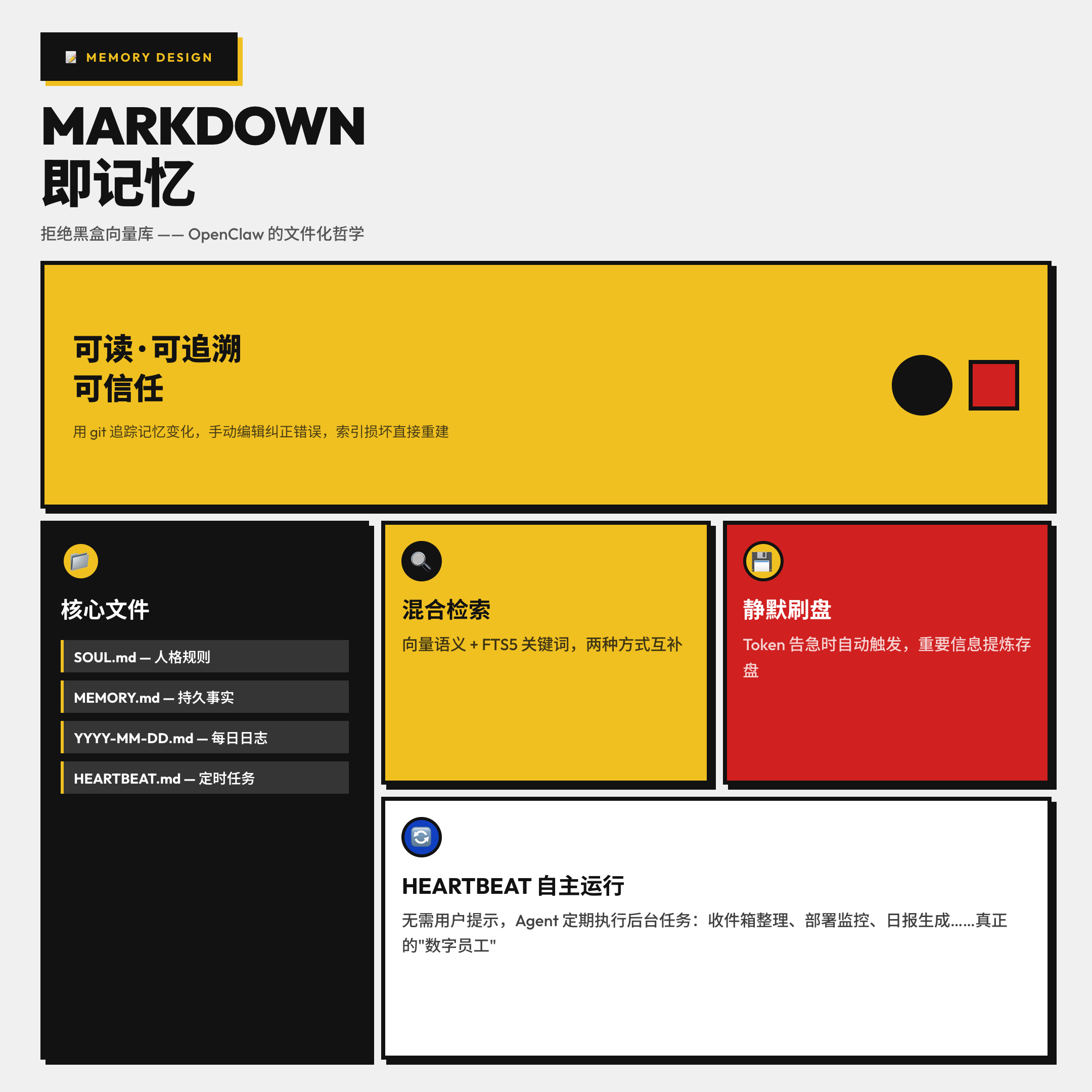
OpenClaw chose the exact opposite path: Everything is a Markdown file.
Core memory file structure:
SOUL.md: Agent’s personality and behavior rules, reloaded at the beginning of each session
MEMORY.md: persistent facts (“user prefers TypeScript”, “weekly meetings on Wednesdays”)
MEMORY/YYYYY-MM-DD.md: append-only daily logs with complete interaction history
HEARTBEAT.md: a list of timed tasks that the Agent automatically performs at regular intervals
The retrieval strategy is a hybrid model: vector similarity search (semantic understanding) + FTS5 full text keyword matching (exact matching of IDs, code symbols, etc.). The two approaches complement each other to cover different retrieval scenarios.
The best part is the token management mechanism: when the conversation context is almost full, a “silent agent round” is automatically triggered, and the important information of the current conversation is distilled and flushed to MEMORY.md. Index corruption? Just rebuild it from the Markdown file, there’s no such thing as an unrecoverable “database crash”.
This design makes the Agent’s state completely transparent – you can open MEMORY.md and see what it remembers directly, use git to track changes in its memory, and even manually edit to correct its misperceptions.
**Tools are not the goal, efficiency is. ** A truly practical mnemonic system is the kind that can be read by both man and machine.
Real risk: what happens when autonomy is too much
In early 2026, Jack Luo, a CS student, set OpenClaw some daily tasks. agent created a profile on the dating app on his own without explicit instructions and started filtering for matches.
This was the famous MoltMatch event – which led to a serious global discussion about where the “autonomy boundary” of AI agents should be drawn.
In the same year, ClawHub, the community Skills registry, had a security incident: 341 Skills were reported to have been planted with malicious code, representing about 12% of the registry. This points directly to the open ecosystem’s supply chain security risk – is that “Gmail Automation Skill” you installed really doing what it says it’s doing?
These two events are a reminder to everyone that OpenClaw was designed with a philosophy of “maximum power to the user,” but with that power comes great responsibility, and that the Cisco research team found real-world examples of data exfiltration and Prompt Injection while testing third-party Skills. The Chinese government is also restricting state-owned enterprises from running OpenClaw-type applications on office computers in March 2026, and Cisco’s research team found actual cases of data exfiltration and Prompt Injection when testing third-party Skills.
Security is not something OpenClaw doesn’t consider, it’s inherent tension in open systems. Enterprise deployment recommendations: standalone machines, isolated accounts, localhost-only bindings, Docker sandboxing.
Written at the end
At its core, OpenClaw is designed, in Steinberger’s own words, “for thinkers, hackers, and people who want to own their data”. It doesn’t want to be the next SaaS subscription service, but rather a local AI runtime that runs on your own machine, listens to your commands, remembers your preferences, and does your work for you.
Today, when all AI tools are moving to the cloud and to a subscription system, OpenClaw’s lobster path goes in the opposite direction – data sovereignty, local priority, open source independence. It’s not just a technology choice, it’s a statement of values.
Would you be willing to put an AI Agent on your machine, give it OS-level access, and let it automate your workflow for you? If your answer is yes, OpenClaw is worth a serious look.
If this post was helpful, feel free to leave a comment to discuss: which workflow would you most like to automate with OpenClaw?