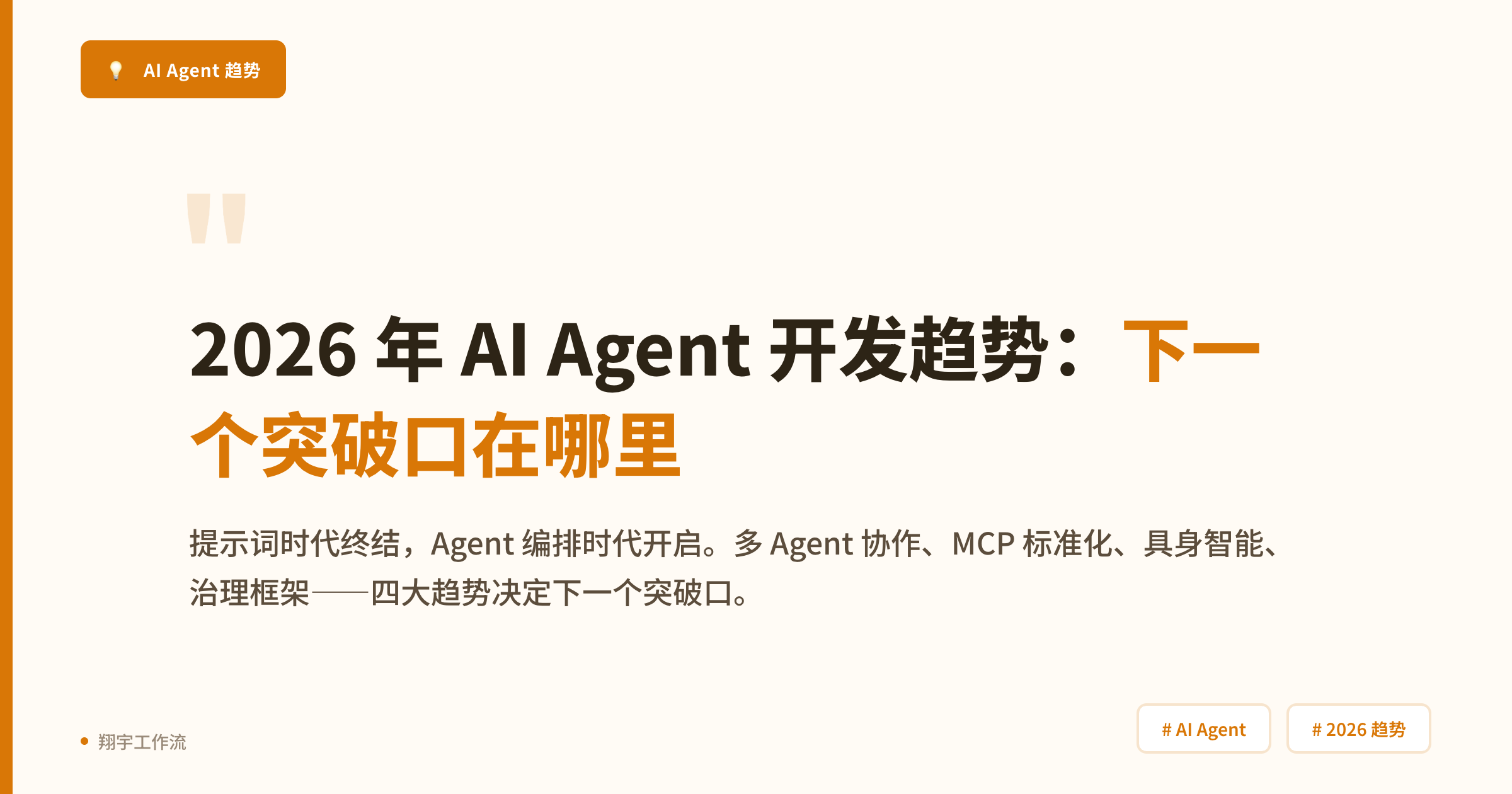
The era of prompts is over, not slowly, but suddenly. Google surveyed 3,466 executives around the world and came to one conclusion: we’re experiencing the “Agent Leap” – AI is no longer just answering questions, it’s semi-autonomously orchestrating entire workflows. If you’re still using ChatGPT to ask and answer questions, you’re already a generation behind.
From Single Agent to Multi-Agent Collaboration: A Paradigm Shift in the Enterprise Digital Workforce
In 2025, we’re still talking about “how to write a good Prompt”, and in 2026, we’re talking about “how to get 10 Agents to work together”.
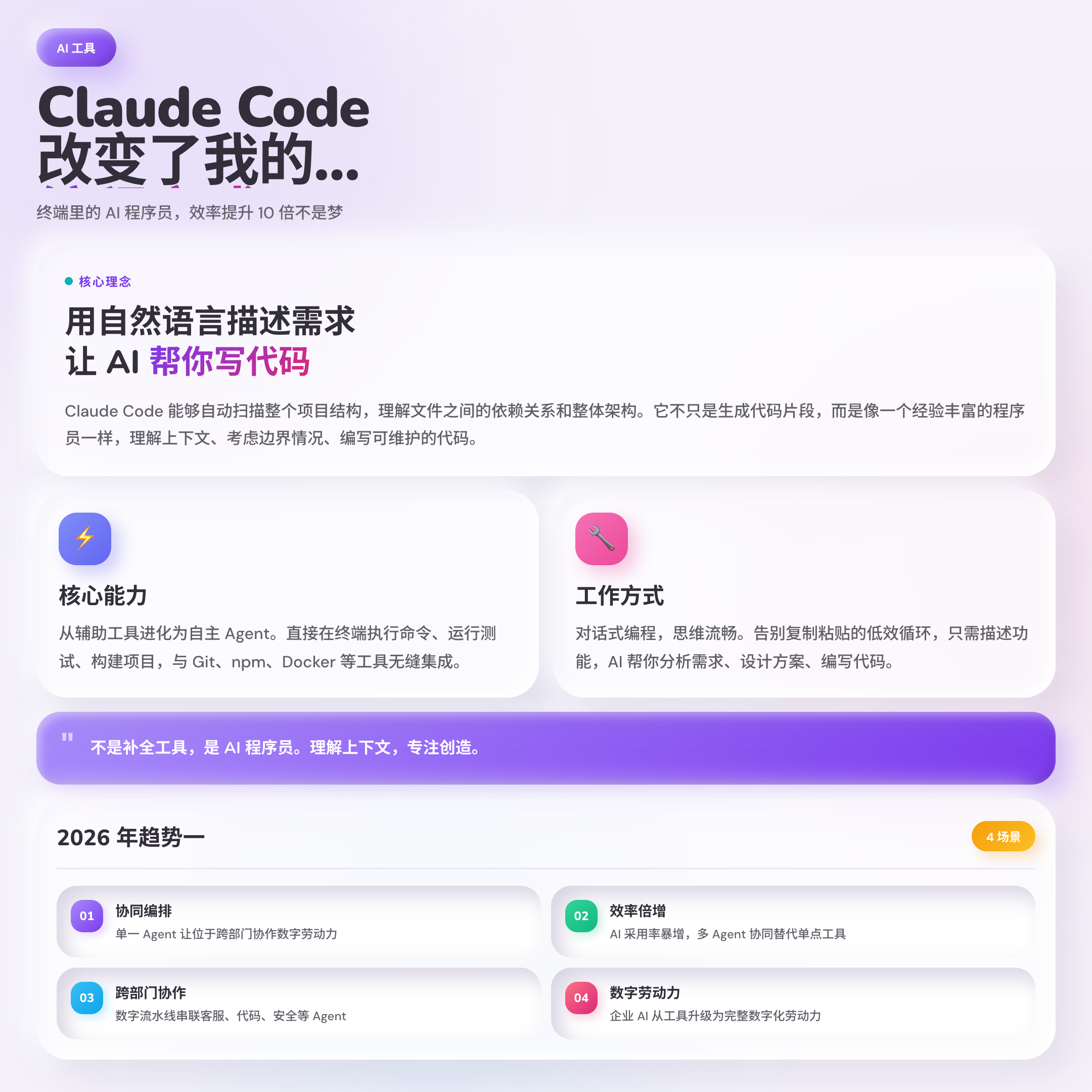
Research data from Salesforce shows that enterprise AI adoption has skyrocketed by 282% (data from Salesforce’s own research, for reference). The more critical change is a qualitative one: single AI Agents are giving way to complete digital workforces that collaborate across departments. Customer Service Agents, Code Review Agents, Threat Detection Agents-they’re no longer siloed; they’re strung together like an assembly line.
Google calls this “digital assembly lines” (digital assembly lines). The analogy is accurate. At the heart of the Industrial Revolution was not the invention of better tools, but the invention of assembly lines, and this leap in AI is essentially the same thing.
**Highlight: AI won’t replace you, those who can use AI will. **
Framework maturity + MCP standardization: an infrastructure revolution for developers
Interestingly, just as enterprise demand exploded, the infrastructure on the development side just happened to mature.
LangGraph, AutoGen v2, CrewAI AMP – all three frameworks will be production-ready by 2026. Gartner predicts that 40% of enterprise applications will be integrated with Agent by the end of 2026 (compared to less than 5% in 2025), and framework maturity is a key driver behind this growth rate.
But the more fundamental change is the emergence of MCP (Model Context Protocol), which does something similar to what the USB interface did for the hardware ecosystem: it standardizes tool access. Previously, each Agent framework had its own way of calling tools, but now there is a unified interface. Now there is a unified interface, which means that developers can write a tool once, and it can be used in LangGraph, CrewAI, and Anthropic SDKs.
It’s not trivial. Standardization is a prerequisite for ecological explosion.
Breakthroughs in the Physical World: Embodied Intelligence Becomes the Next Battleground
The Agent competition in the software world is white-hot. The real blue ocean is in the physical world.
Google DeepMind’s launch of Gemini Robotics 1.5 is a sign of things to come. It’s a vision-verbal-action model that learns across different robot forms to “think before it acts,” which DeepMind itself describes as a landmark step toward the physical world of AGI.
In the same period, SIMA 2 demonstrated another direction: the ability to develop skills in never-before-seen 3D worlds through autonomous game learning without additional artificial data. This means that the Agent’s ability to evolve itself is becoming a reality.
**Simplify the complex and standardize the simple. **
The challenges facing Agents in the physical world are much more complex than in the software world – perception, action, real-time feedback, security constraints. But it’s precisely because it’s hard that it’s a real breakthrough.
Real bottlenecks: verifiable planning, persistent memory, governance frameworks
All this talk of trends, but the question remains: why hasn’t Agent landed on a large scale yet?
Two 2026 papers on arXiv provide sobering answers. One systematizes the evolution of multi-agent systems, pointing out that LFM (Large Foundational Model)-driven multi-agent systems have upgraded from low-level state exchange to semantic-level reasoning-a qualitative leap. Another article directly points out three core challenges:
Verifiable Planning: the Agent makes a decision, how do you know its reasoning process is right? Right now it basically relies on trust, which doesn’t work in high-risk scenarios.
Persistent Memory Architecture: Agent Memory management across tasks and sessions is still a challenge. Complex workflows cannot be sustained when each conversation starts from zero.
Governance framework: Who is responsible for Agent decisions? How to trace back when something goes wrong? This is not a technical problem, it is a systemic problem.
What many people ignore is: these three problems are not solved, the scale of Agent deployment is empty talk. Technical ability is already enough, stuck is the credibility and controllability.
**The most dangerous thing is not that you won’t, but that you think you will. **
Written at the end
The breakthrough for AI Agents in 2026 will not be in which stronger model comes out again, but rather:
Multi-Agent Collaboration moved from concept to engineering practice
MCP standardization allows the tool ecosystem to start converging
Physical world becomes the next competitive dimension
Governance and Memory are the real bottlenecks to getting off the ground
Instead of chasing every new model release, focus on figuring out these four things.Agent The time has come, but the real dividends belong to those who put the foundations in place.
I hope this article helped you see your way clearer. Feel free to leave a comment and discuss if it helps.
If this article was helpful to you, feel free to leave a comment to discuss.