
“Help me write a poem.”” Explain quantum mechanics to me.” –In the past two years, the ability of the Large Language Model (LLM) has been amazing, but it has always been a “passive responder”: if you ask, it answers; if you stop, it stops. The AI Agent wants to break this pattern by not just answering questions, but actively sensing, autonomously planning, and actually getting things done. This article with a core question throughout: what is the AI Agent, and what is the essential difference between it and the big model?
AI Agent is not a “smarter chatbot”
When many people hear “AI Intelligence Body” for the first time, they think it is an upgraded version of ChatGPT, which is wrong.
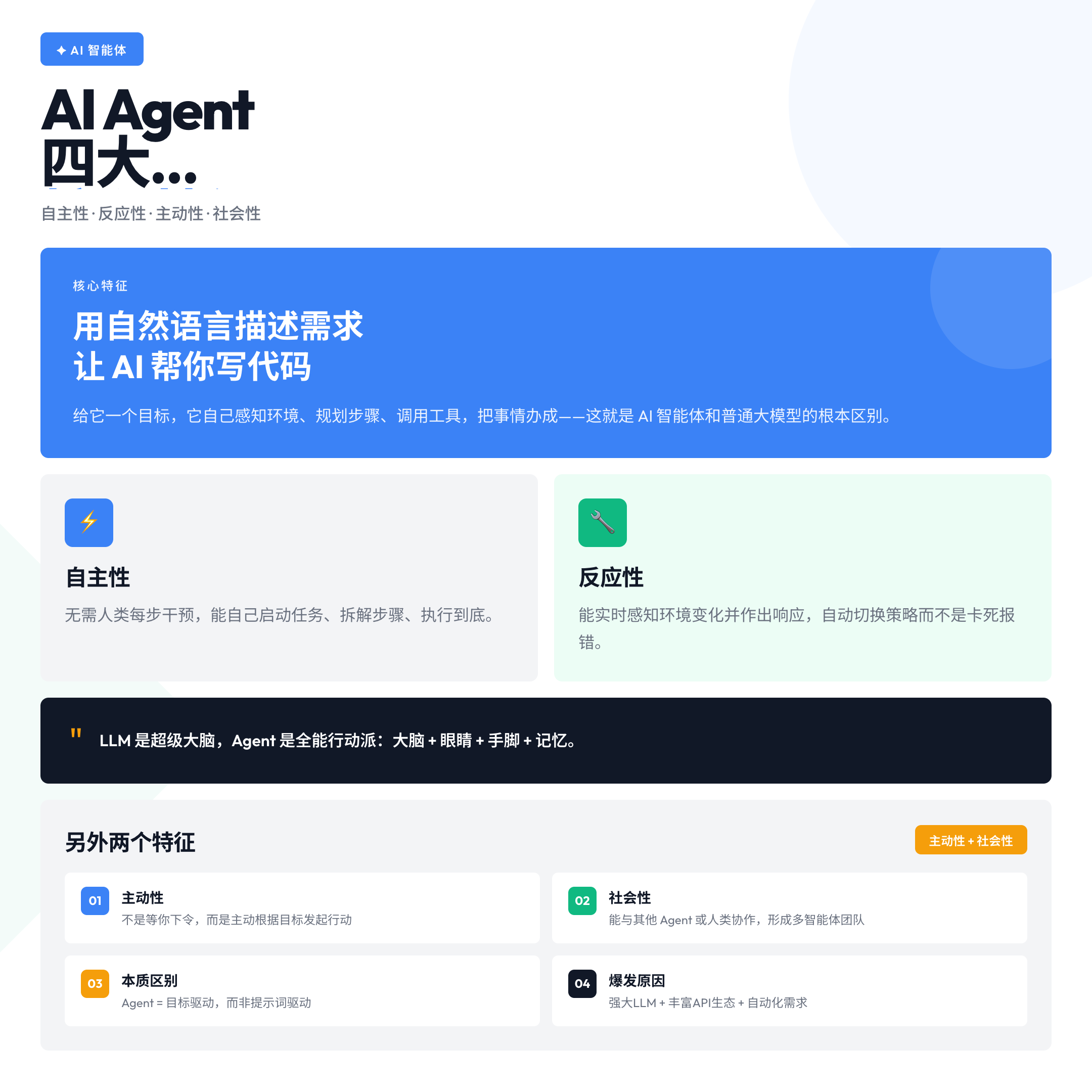
** The Big Language Model is a superbrain, but it has no arms, legs, or eyes. ** It can reason and generate content, but it can’t interact with the outside world on its own, it can’t invoke tools, perform tasks, or memorize context to do things on its own accord.
The AI Agent is based on the “brain” of the LLM:
- Eyes (sensing module): can read external data, sense changes in the environment
- Hands and feet (tool invocation): can call search, API, database, code execution and other tools
- Memory (short-term + long-term): can remember the current task status and historical experience
In a nutshell:**LLMs are brains that think, Agents are employees that work. **
The definition given by Stuart Russell in Artificial Intelligence: A Modern Approach (1995) is still accurate today:
An agent is anything that can be viewed as perceiving its environment through sensors and acting upon that environment through actuators.
Translated into human language: a system that can sense the environment and take action to achieve a goal is an Agent.
Four core features that make an Agent radically different from ordinary AI
To determine if an AI system is a true Agent, you can check against these four characteristics:
1. Autonomy
Can initiate tasks, disassemble steps, and execute to the end on its own without every step of human intervention. Give it a goal and it figures it out on its own.
2. Reactivity
Can sense and respond to changes in the environment in real time. For example, if it finds that an API reports an error while performing a task, it will automatically switch strategies instead of getting stuck.
3. Proactivity
Instead of passively waiting for your instructions, it actively initiates actions based on goals. This is the core difference with chatbots.
4. Sociality
The ability to collaborate with other Agents or humans. In a multi-agent system, agents with different specialties work together as a real team.
Key point: **Agent is essentially “goal-driven”, not “cue-driven”. **
A case study to understand the gap between Agent and LLM in seconds
The most visual comparison: travel planning.
Traditional LLM method:
You ask ChatGPT “What should I pay attention to when traveling in Japan during the cherry blossom season?” –It generates a generic list. Next you have to search for airfare, check hotels, plan routes, and switch between a dozen apps over and over again.
AI Agent method:
You say to the Travel Agent, “Plan a 7-day cherry blossom viewing trip to Japan in March 2026 with a budget of 15,000 yen.”
It will:
– Automatically crawl current airfares and hotel availability
– Deconstruct subtasks: booking flights / booking hotels / arranging itineraries / visa documents
– Call the booking API to generate a complete roadmap
– If you reject a hotel, it will remember your preference next time.
You only need to make decisions at key points, and leave the rest to the Agent. This is the paradigm shift of AI from “conversation” to “action”. This is the paradigm shift from “conversation” to “action” in AI.
Agent’s core components: four pieces of the puzzle are missing
The official Google Cloud documentation (updated April 2026) gives the four core components of an Agent:
| Components | Functions |
|---|---|
| Role | Defines an Agent’s personality, communication style, and behavioral boundaries |
| Memory | Short-term (current session) + Long-term (historical data) + Scenario Memory |
| Tools | external functions that can be called: search, code execution, database, API, etc. |
| Model | LLM acts as the “brain”, responsible for reasoning and decision making |
The memory system deserves a separate comment. Many people think that Agents only have context windows. In fact, a mature Agent has four layers of memory:
– short-term memory: the real-time context of the current session
– Long-term memory: historical experience stored in a vector database
– Situational memory: records of past interactions, supporting cross-session learning
– Consensus memory: information shared between multiple Agents
How does an Agent work, with the ReAct loop at its core?
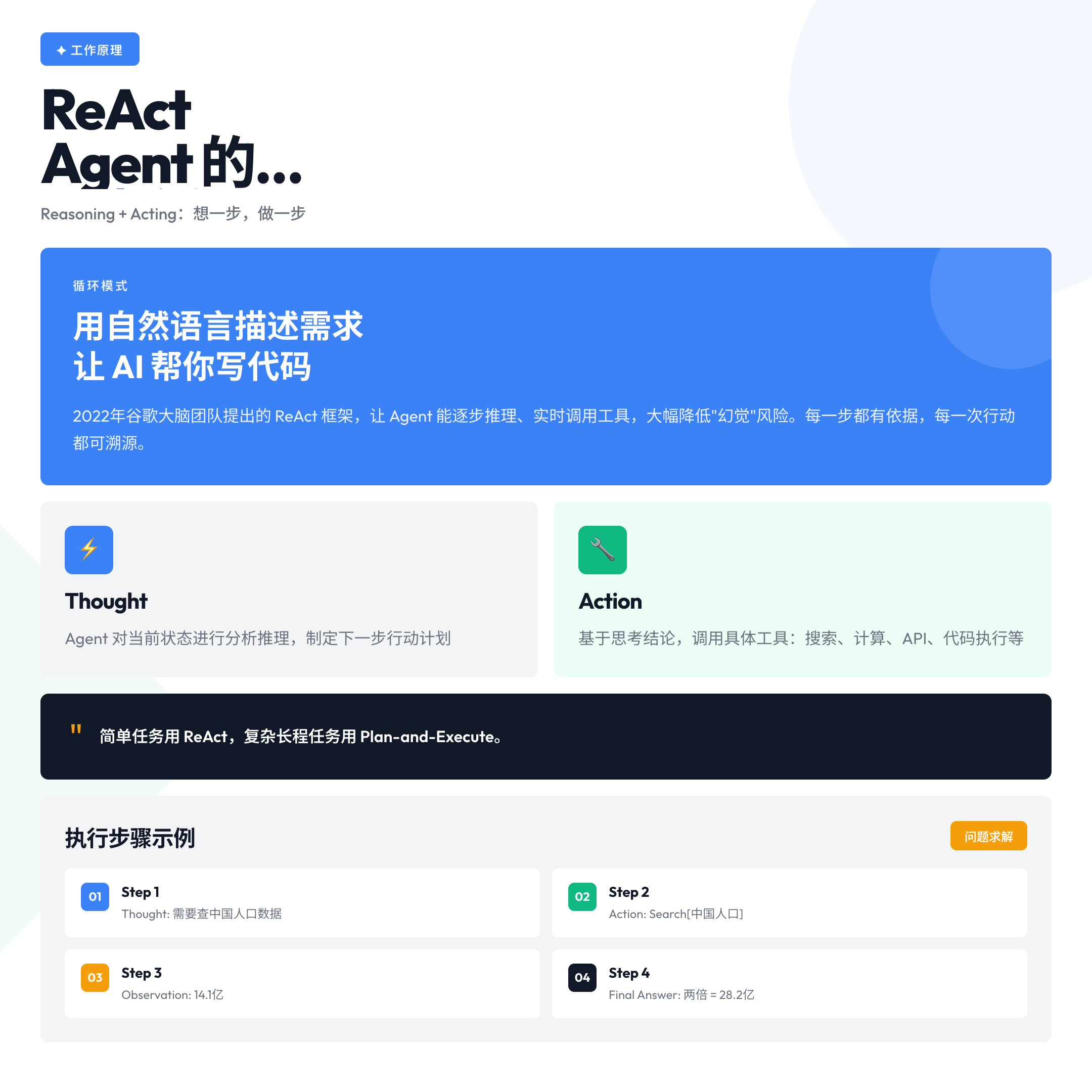
The most dominant Agent working model today is called ReAct (Reasoning + Acting), proposed by the 2022 Google Brain team.
The core idea is simple:** Think one step, do one step, look at the results, and think of the next step. **
Thought:我需要先查中国的人口数据
Action:Search[中国人口]
Observation:中国 2023 年人口约 14.1 亿
Thought:好的,那两倍就是 2 × 14.1 亿
Action:Calculator[2 × 14.1亿]
Observation:28.2 亿
Final Answer:约 28.2 亿
This think-act-observe cycle allows the Agent to reason step-by-step, invoke tools to obtain information in real time, and dramatically reduce the risk of “hallucination”.
For more complex tasks, there is also the Plan-and-Execute model: Planner generates the full execution plan and then Executor implements it step-by-step. It is suitable for multi-step, long-range, cross-tool coordination tasks. Principle of choice between the two: ReAct for simple tasks, Plan-and-Execute for complex tasks.
From Expert System to LLM Agent: A Three-Generation Evolutionary History
The concept of an AI Agent is not new, but it’s only in the last few years that it’s really practical.
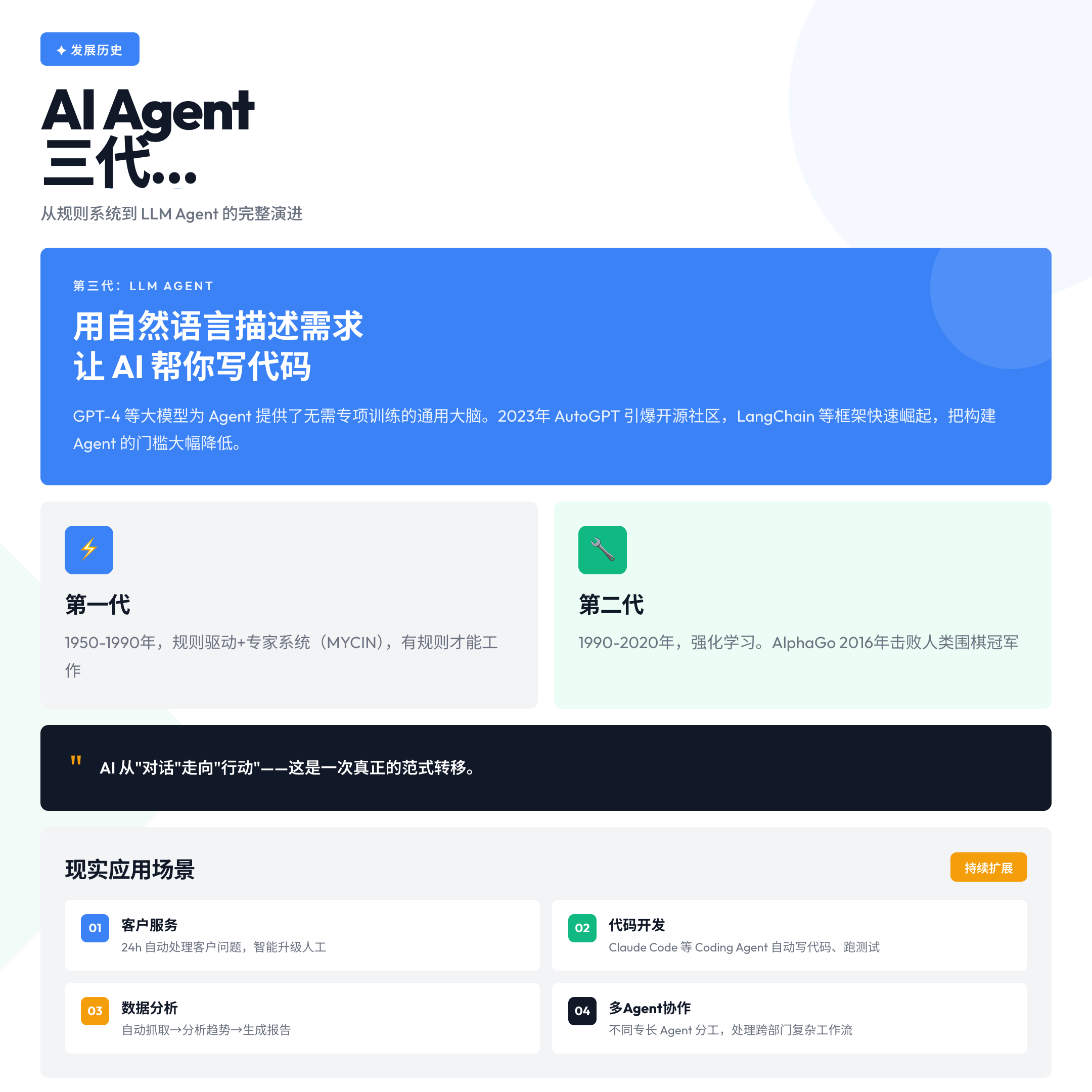
First Generation (1950-1990): Rule Driven
Represented by expert systems, such as the medical diagnostic system MYCIN. rules are manually written if-then logic, specialized but not living, and can do nothing when encountering scenarios not covered by the rules.
Generation 2 (1990-2020): Reinforcement learning
Agents begin to learn strategies autonomously through trial and error and environmental interactions. 2016’s AlphaGo defeat of the human Go world champion was the pinnacle of this era. However, Reinforcement Learning Agents require extensive training, are specialized for specific tasks, and lack generalizability.
Third Generation (2020s-present): LLM Agent The emergence of large models such as GPT-4 provided a generalized “brain” for agents without specialized training.
The emergence of large models such as GPT-4 provided agents with a generalized “brain” that did not require special training. 2023 AutoGPT exploded in the open source community, triggering a wave of LLM agents, and the rapid rise of frameworks such as LangChain and LlamaIndex drastically lowered the threshold for building agents.
**The core breakthroughs of this generation of Agents: no specialized training is required, natural language is used as the interface, and open tools and knowledge sources can be invoked. **
Three broad categories of application scenarios for AI Agents
Agent is not a toy, it is literally being implemented in every field:
Customer Service Agent: 24-hour understanding of customer needs, problem solving, escalation to manual when necessary, seamless cross-channel switching.
Code Agent: Claude Code, GitHub Copilot Workspace, etc. Understand requirements, write code, run tests, fix bugs, and automate the entire development workflow.
Data Analysis Agent: Automatically captures data, analyzes trends, and generates reports, replacing a lot of repetitive analysis work.
Multi-Agent Collaboration System: Agents with different specialties work together to handle complex workflows across departments and tools.
Interesting: the value of the AI Agent is not in replacing people, but in enabling one person to do what would otherwise take a team to do.
Written at the end
The core logic of an AI intelligent body is, in fact, very simple: **Give it a goal, and it figures out how to fix it on its own. **
AI is completing a paradigm shift from “librarian” (answering questions) to “omnipotent butler” (proactive). This is not just a technology iteration, but a fundamental change in the way AI collaborates with humans.
Chances are, the AI tools you’re using right now are still in the “chat” phase. Next, it’s worth taking a hard look at what Agent can bring to your workflow.
If this article was helpful to you, feel free to leave a comment to discuss – Which job pain point would you most like AI Agent to help you solve?