
On January 26, 2026, a project on GitHub added 25,310 Stars in a single day, breaking the platform’s all-time record. This project is called OpenClaw, or “Lobster” in Chinese. 180K+ Stars, a milestone that took React 8 years and Linux 12 years to reach, took less than 3 months. Is it worth using something so hot? I’ll give you a rundown from real-world feedback from multiple real users.
What the hell is OpenClaw?
OpenClaw is not yet another chatbot. It’s an open source AI Agent framework with one core logic – let the AI take the initiative instead of waiting for you to open it.
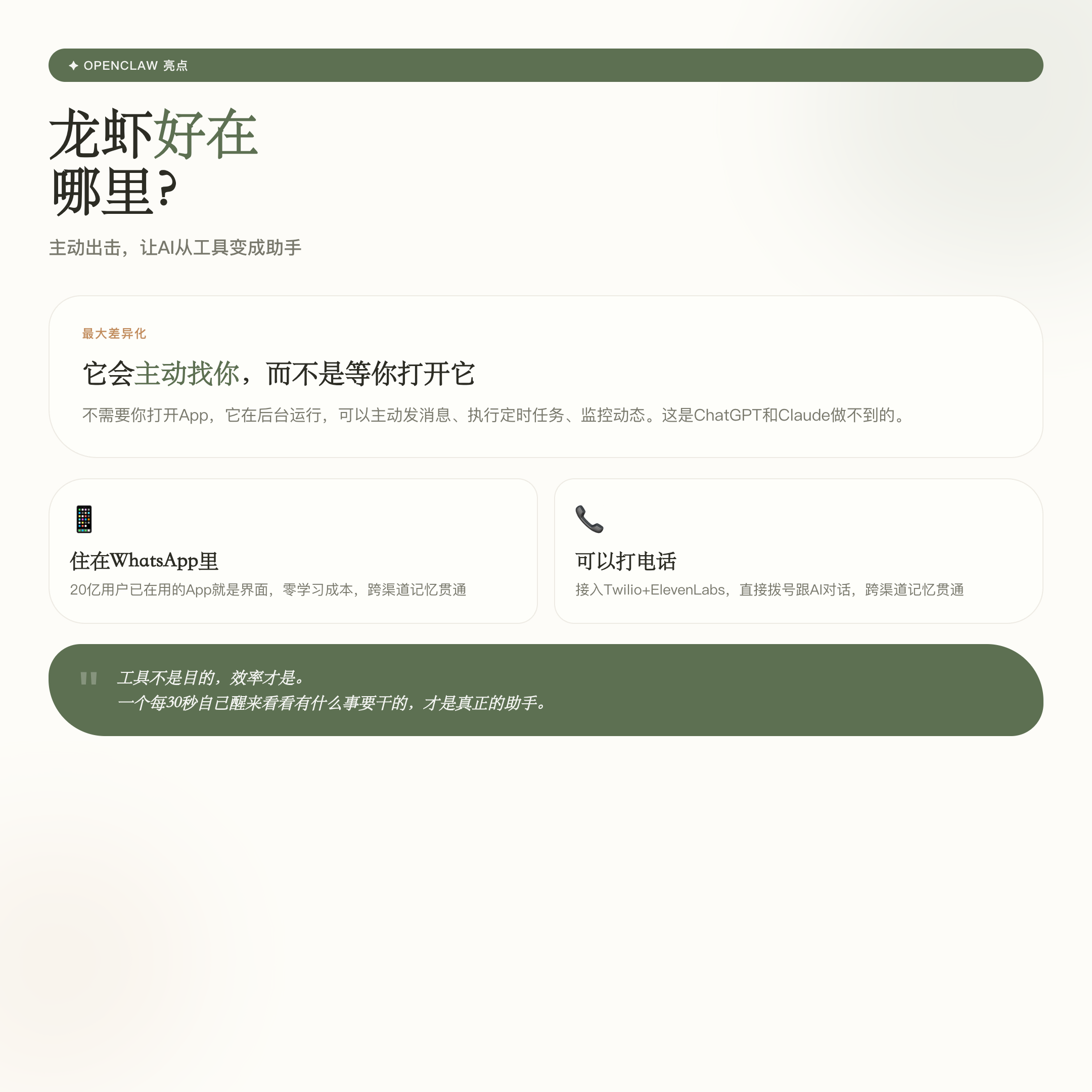
ChatGPT, Claude and other tools work like this: you do not open it, it does not move. OpenClaw design ideas completely the opposite – it runs continuously in the background, can actively send you messages, automatic execution of timed tasks, monitoring the dynamics of competing products, in the early morning to help you finish organizing yesterday’s work log.
“A thing that doesn’t move until the user calls it is a tool, a thing that wakes up by itself every 30 seconds to see what’s going on is an assistant.” This statement makes clear the difference in its positioning.
The project was created by Austrian developer Peter Steinberger. He was the founder of PSPDFKit, and after selling the company for about 100 million euros in 2021, instead of going on vacation – he started to build the AI Agent. one weekend in November 2025, he wrote the initial version in one day.
What’s so good about the real thing
Multi-channel access, the interface is right on your phone
The smartest design of OpenClaw is not the features but the interface choices. It supports WhatsApp, Telegram, Discord, Slack, iMessage, Enterprise WeChat, Flybook and 20+ other channels. Your AI assistant lives directly in your WhatsApp, and the app you chat with your friends is the interface you work with AI, with zero learning cost.
Cross-channel persistent memory
In the morning, tell it on Telegram that you are going to prepare a product presentation today, and in the afternoon, ask it on WhatsApp to “help me optimize the PPT outline”, it knows what you are talking about. A normal chatbot has to re-explain the context every time, OpenClaw theoretically doesn’t have to.
The voice call feature is the most futuristic experience of the year*
With Twilio (phone) and ElevenLabs (speech synthesis), you can directly call AI. A user describes: dialing a number in a cafe, hearing an “almost human” voice, talking to it about the progress of the project, it remembers what it said in Telegram yesterday, and offers to ask follow-up questions – the waiter next to it gives him a strange look.
Scratch that:** This is the closest interactive experience to a sci-fi movie in consumer-grade AI today. **
Open source ecosystem has great potential
MIT Protocol, 180K+ Stars, 5400+ plugins. The community has contributed all kinds of plugins from office automation to server management. Models are not bound, you can pick up Claude, GPT, DeepSeek, and even local models. Data is not on the cloud, privacy is more controllable.
What’s the real difference
The first one is very dissuasive: burning money
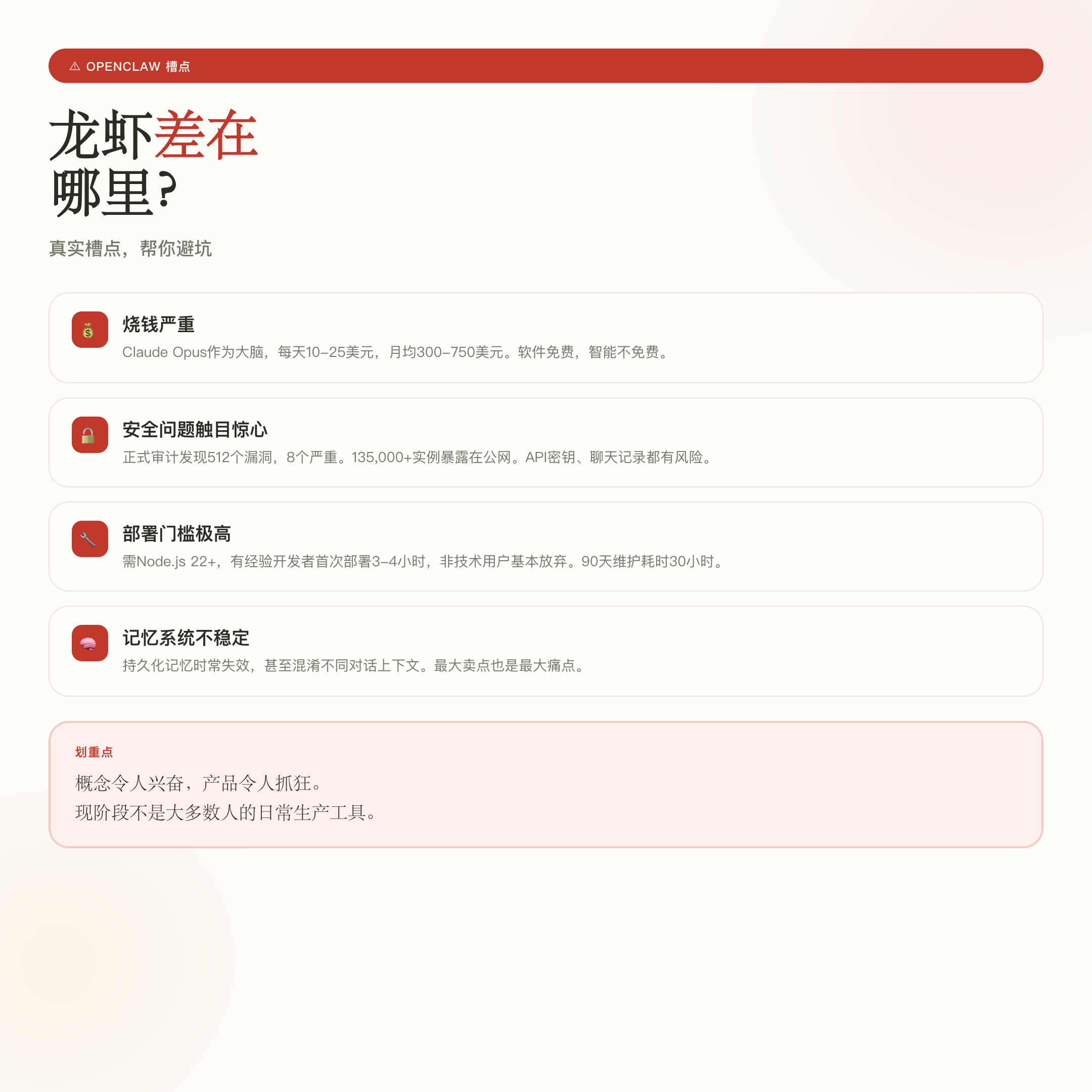
Using the Claude Opus as the Agent’s “brain” costs $10-25 per day, which is $300-750 per month. That’s $300-750 a month, and even if you downgrade to a cheaper model, it’s still $40-200/month. The software itself is free, but the “intelligence” is not. Someone paid $400 to test various workflows and rated it 6.5 out of 10.
If you use domestic free models (e.g. Kimi’s free quota, DeepSeek) for the backend, the cost will drop dramatically, but the results will also be compromised. It’s a trade-off.
Security is not a trivial matter
A formal security audit identified 512 vulnerabilities, 8 of which were at the critical level. The most dangerous is CVE-2026-25253, with a CVSS score of 8.8, a remote code execution vulnerability that can be triggered with a single click, which was fixed in v2026.1.29. But the bigger issue is this: There are over 135,000 OpenClaw instances across the network that are directly exposed to the public network, and many of these users have not yet updated.
If you’re running a publicly accessible OpenClaw right now, your API keys, chat logs, and even message sending privileges could be in someone else’s hands. This is not alarmist talk.
Thresholds are not friendly to ordinary users
To run it, you need: Node.js 22+, terminal operation capabilities, API keys from at least one LLM provider, and separate configurations for each messaging platform. The first deployment takes 3-4 hours for experienced developers, and most non-technical users give up halfway through.
One CEO-level user did the math: in 90 days, it took 30 hours just for initial configuration + routine maintenance. At any reasonable hourly rate, this “efficiency machine” is itself a drain on efficiency.
Memory system not stable enough
Persistent memory is the biggest selling point and the biggest pain point. It sometimes works properly, sometimes forgets what was said yesterday, and sometimes mixes up the context of different conversations. When it works, the experience really exceeds expectations; when it fails, you’re just talking to a forgetful robot.
Updates too quickly, poor stability*
Steinberger, the project’s founder, once said, “I SHIP code that I haven’t even read myself.” This statement is both a compliment and a warning. The code is updated almost daily, the configuration can change at any time, and plugins often fail with version upgrades. Ignore it for two weeks and I’m not sure how many features will still work properly.
Who’s fit to use and who’s not
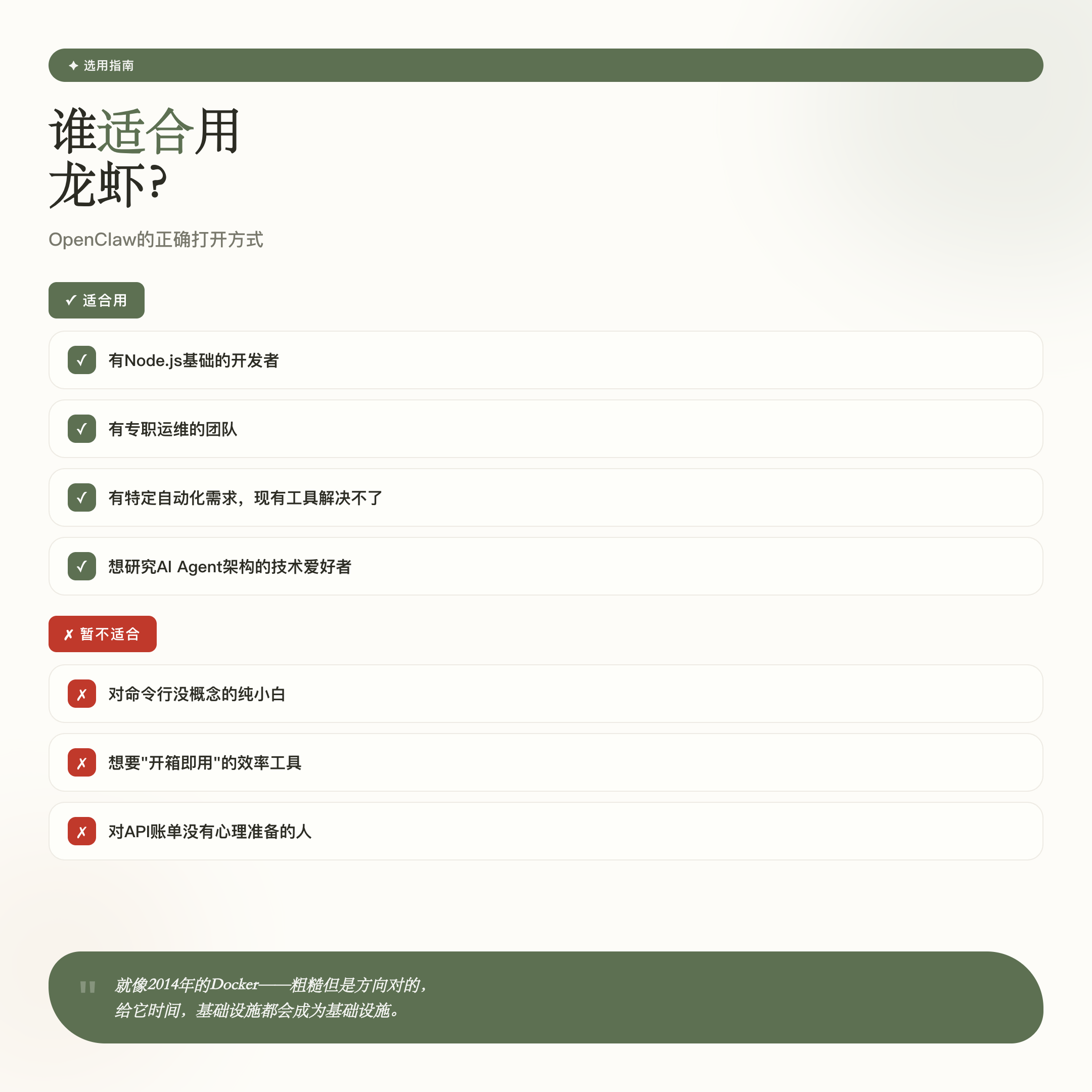
For whom it is suitable:
– Developers with a basic knowledge of Node.js who can toss the endpoints around
– Teams with dedicated ops/technicians who can share maintenance costs
– Scenarios with specific automation needs that can’t be solved by existing tools (e.g. customized data pipelines, monitoring tasks)
– Technology enthusiasts who want to try and study AI Agent architecture
Temporarily unsuitable people:
– Pure novice users who have no idea about command line.
– Those who want an “out-of-the-box” efficiency tool.
– People who are not mentally prepared for API billing.
– Those who rely on it as a stable production tool.
A very interesting perspective: OpenClaw is more like the Docker of 2014 – rough, with security risks, needing to be tossed, but building a new class of infrastructure. People who used Docker back then are enjoying the dividends of containerization today. the underlying logic of OpenClaw (persistent Agents, multi-channel access, inter-Agent communication) is a real need, not a gimmick.
Written at the end
OpenClaw Lobster is in a state that is, in a word: **Exciting concept, gripping product. **
It’s demonstrating a real and viable paradigm for the use of AI – the active, cross-channel, persistent-memory Agent. that’s a step in the right direction. But today’s version of the implementation is not yet a daily production tool for most people.
If you’re a developer, it’s well worth spending a weekend building one to get a feel for it. If you just want the AI to do the work for you, it’s much less of a hassle at this stage to use Claude Code or one of the off-the-shelf tools available in the country.
Tools are not the goal, efficiency is. Don’t let a 180K Star number kidnap your judgment.
If you’ve used OpenClaw or have any thoughts on AI Agent, feel free to leave a comment to discuss.